

The velocity of money
The velocity of money is a measure of how quickly a unit of currency circulates in an economy by purchasing domestically produced goods and services within a given period of time. A simple way to think about it is how many times a unit of currency, say a single dollar, pound or euro, is spent within a certain time frame in the respective economies of the US, UK and EU.
Money velocity is calculated by dividing a nation’s gross domestic product (GDP) or gross national product (GNP) by M1 or M2 money supply. M1 being all the currency held by the public as cash or in their current accounts and M2 being a broader, less liquid measure that includes M1 along with savings, time deposits and money market funds.
Even though you don’t tend to hear about money velocity as often as many of the other economic indicators you may be aware of, it’s regarded by many as an important yardstick of economic activity and health. The idea is that an expanding economy will exhibit a higher velocity of money as consumers and businesses are more willing to spend. In a thriving economy, the same dollar, pound or euro is rapidly spent over and over again.
A contracting economy, on the other hand, will demonstrate a lower velocity of money as individuals and businesses hold off on spending in anticipation of harder times ahead. In situations such as this, a single dollar, pound or euro is saved in order to be spent on a rainy day when it will most be needed.
The velocity of money essentially changes as a function of two data points: how fast the economy is expanding, and how fast the money supply is growing. As mentioned above, slowing money velocity amid slowing growth is a possible recession indicator. However, in situations where the money supply is growing faster than the economy, there are fears that inflation could be on the horizon because there is more money in circulation chasing the same number of goods and services, which can lead to prices rising. This, evidently hasn’t been an issue post-2008, where quantitative easing programs have massively increased the money supply while failing to generate convincing growth or inflation.
Keynesians vs Monetarists
Broadly speaking, there are two opposing schools of thought that you should be aware of. Keynesians subscribe to the theories of British economist John Maynard Keynes, who believed that governments should intervene to rescue flagging economies by lowering taxes and increasing government spending initiatives.
The monetarists, on the other hand, who take their lead from the American economist Milton Friedman, believe that governments should leave markets alone, that economies are driven by the money supply and that inflation expectations and interest rates can both be influenced by increasing or decreasing the supply of money in an economy.
Keynesian economics held sway in the wake of the Great Depression and WWII, while monetarism had been the order of the day in more recent times. Most notably post-1970, where monetarism became increasingly popular in political circles because Keynesian theories were unable to explain the combination of rising unemployment and inflation following the collapse of the Bretton Woods system and the gold standard.
Since the 1990s, monetarism has been thrown into question in a similar manner that Keynesianism was in the 1970s. One of the reasons for this has been that monetarism has struggled to explain the scenario we discussed above, where the money supply grows without the economy growing or inflation increasing. This has been the legacy of the massive central bank interventions that have taken place in recent decades.
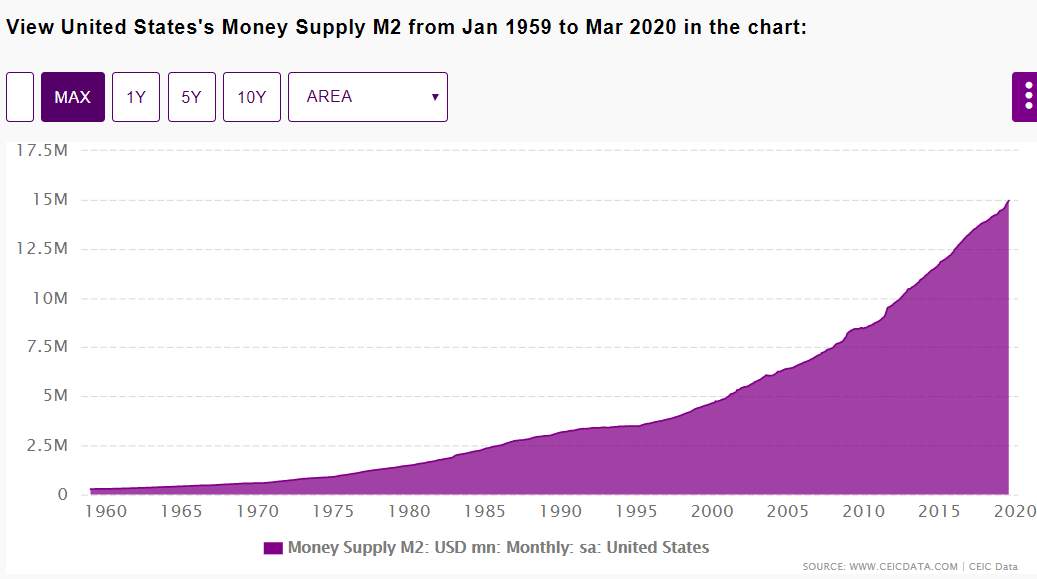
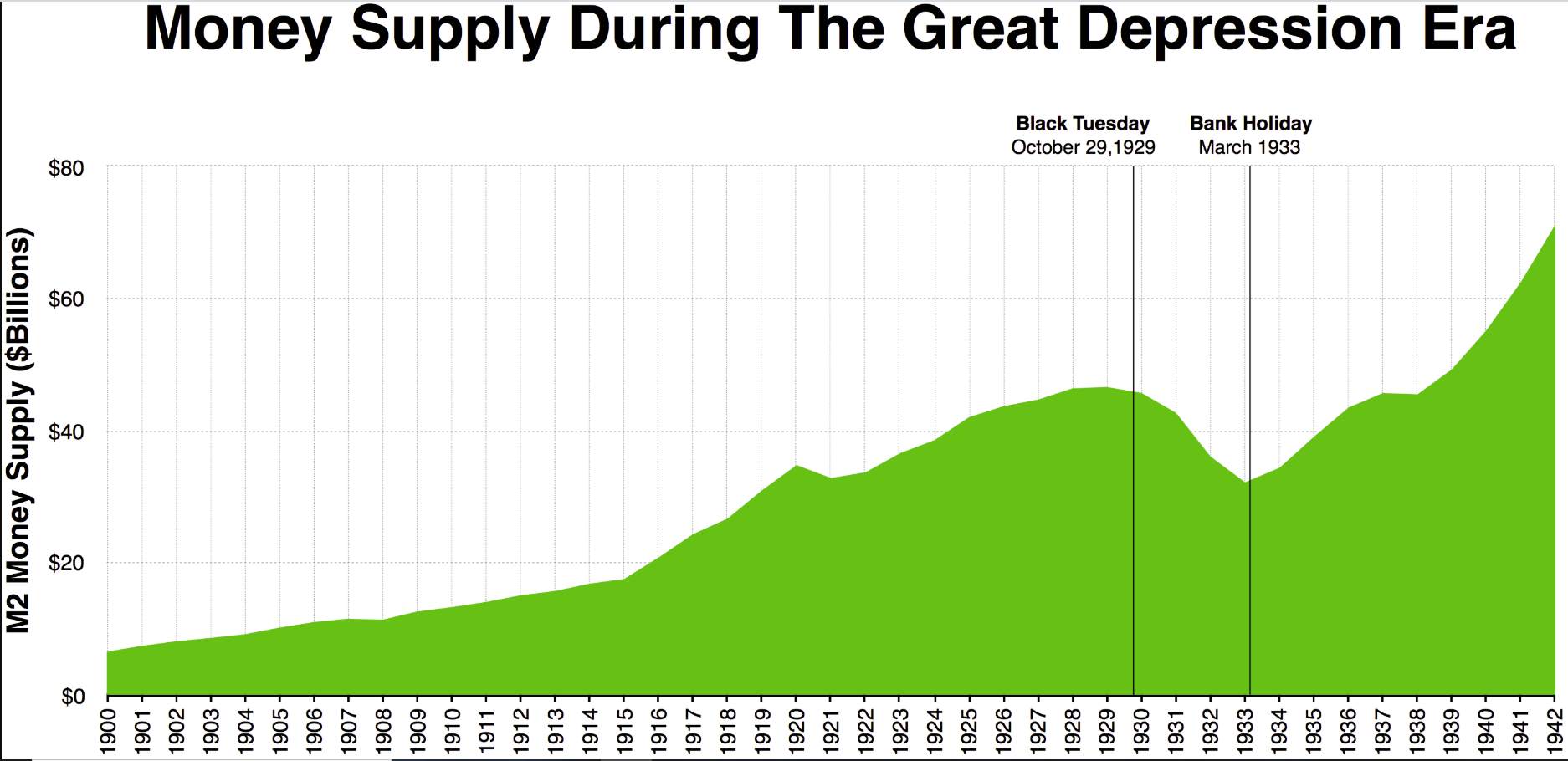
Keep in mind that in practice it’s not an either-or situation. Throughout history, a combination of both approaches has been used during economic calamities. You may remember President Roosevelt’s “New Deal” from your history class. Introduced in the 1930s to combat the Great Depression, Roosevelt’s government spending increased employment and consumption but, as you can see below, also had the effect of increasing the money supply. Similarly, in the wake of the 2008 crisis, the money supply was greatly increased as you can see in the chart above. However, President Obama also signed the American Recovery and Reinvestment Act of 2009, a government spending programme that would stimulate the American economy to the tune of $831 billion between 2009 and 2019.
So, What's the Problem?
Well, the problem is the chart below, which shows the velocity of money in the US going all the way back to the late 1950s. If you compare where money velocity peaks in the second half of 1997, just before the Dot-com bubble burst, to the most recent point on the chart, you can see that one goes almost straight up, while the other goes almost straight down. This is all part of what has come to be known as the “new normal” since the Great Financial Crisis; a topsy-turvy world in which the old rules don’t apply, where interest rates can go negative and inflation remains low, where money velocity stalls while stock markets march onwards and upwards.
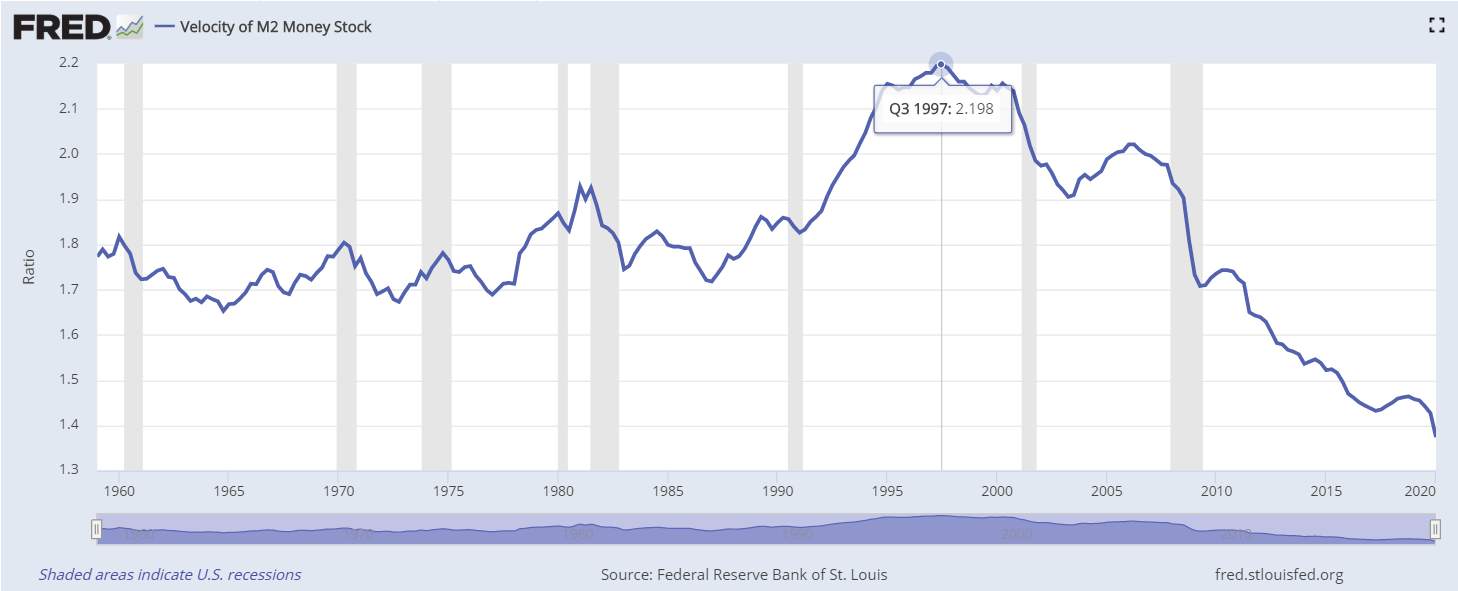
The velocity of money briefly became a talking point back in 2017 when it hit new all-time lows. At the time it was explained away by some pundits as not being a problem due to the aforementioned new normal in which recent monetary expansions had increased the money supply faster than the economy could keep up without creating inflation. Then Trump’s tax reforms came into effect and money velocity began to tick up again, allaying people’s fears.
The commentators that found little to worry about in this 'new normal' often neglected to mention that much of this newly-created money was actually being hoarded by the very banks that were supposed to be jump-starting the economy by lending it out. In fact, far from trickling down to the man and woman on the street, the unprecedented monetary expansion we have witnessed since 2008 has been used to inflate asset prices, real estate bubbles, art and other luxury goods valuations, as well as finding its way into the shadow banking system. Could this possibly have anything to do with that incredibly strange-looking money velocity chart? What’s more, the coronavirus crisis seems to have exacerbated the situation, both in terms of increasing money supply as seen in the first chart and decreasing money velocity as seen above.
Ray Dalio may have called it wrong with his pre-coronavirus pronouncement that “cash is trash,” however, he has also been very vocal that if the new normal continues for much longer, he expects to see mobs with pitchforks and torches in the streets before long. If Covid-19, the subsequent global lockdown, and its economic consequences don’t have the effect of changing the status quo, you have to wonder if anything will.
Reprinted from Investing.com,the copyright all reserved by the original author.
คำชี้แจง (Disclaimer) : เนื้อหาข้างต้นเป็นเพียงมุมมองของผู้เขียนแต่เพียงผู้เดียว และไม่ได้แสดงหรือสะท้อนถึงจุดยืนอย่างเป็นทางการของ Followme แต่อย่างใด Followme ไม่รับผิดชอบต่อความถูกต้อง ความครบถ้วน หรือความน่าเชื่อถือของข้อมูลที่ปรากฏ และจะไม่รับผิดชอบต่อการดำเนินการใด ๆ ที่เกิดขึ้นจากเนื้อหานั้น เว้นแต่จะมีการระบุไว้เป็นลายลักษณ์อักษรอย่างชัดเจน

เขียนข้อความของคุณตอนนี้