



ByJin Dao Tai
NOV 4, 2021
Bank of Canada: The end of QE
The Bank of Canada (BoC) surprised the market during their monetary policy meeting last Wednesday with the termination of the ongoing C$2 billion per week quantitative easing (QE). This action was carried out “in light of the progress made in the economic recovery”. Specifically, the central bank highlighted that strong economic growth has resumed after the economy took a hit back in the second quarter due to a third wave of COVID infections and lockdowns across Canada.
The BoC has also revised its inflation projection upwards for 2021, 2022 and 2023, citing that higher energy prices and the ongoing supply chain bottlenecks “now appear to be stronger and more persistent than expected”. As a result, the central bank revised its economic growth projection downwards for 2021 and 2022 due to the possibility of a narrower economic output gap than previously forecasted. Nonetheless, with strong consumption and business investments, the BoC is expecting demand to be supported.
Bank of Canada hints at earlier rate hike timeline
Adding on to the hawkish tone, the BoC is now expecting its first interest rate hike to take place earlier than its previous projection. In the released rate statement, the central bank highlighted that its 2% inflation target is expected to be sustainably achieved “sometime in the middle quarters of 2022” while in the previous statement, it was expected to be “in the second half of 2022”. And since the BoC is committed to keeping interest rate at its current level until the inflation target is met, an earlier timeline for achieving the target implies the possibility of an earlier rate hike.
With the conclusion of QE, the BoC has now entered the reinvestment phase. Moving forward, the central bank will continue to purchase bonds only to replace the maturing ones so that the overall holdings will remain roughly stable over time.
Bank of England expected to hike rate this year
Back in September’s meeting, the Bank of England (BoE)’s committee members unanimously agreed that future monetary policy tightening should be carried out in the form of interest rate hike, even if it is to be carried out prior to the end of its QE programme. As a result, the market is now expecting a rate hike from the central bank as early as its monetary policy meeting this Thursday.
OPEC+ likely to stick with 400,000 bpd increase for December
Oil prices have been rising as attempts made to pressure the OPEC+ to increase production were to no avail. The group of oil producing countries and its allies decided back in July’s meeting that a 400,000 barrels-per-day (bpd) production hike on a monthly basis is adequate and will allow them to phase out the oil production cut by September 2022. Coming Thursday during their meeting, if the group decides to stick with a production hike of 400,000 bpd, it is likely that oil prices may continue to trade higher, in turn strengthening the Canadian dollar.
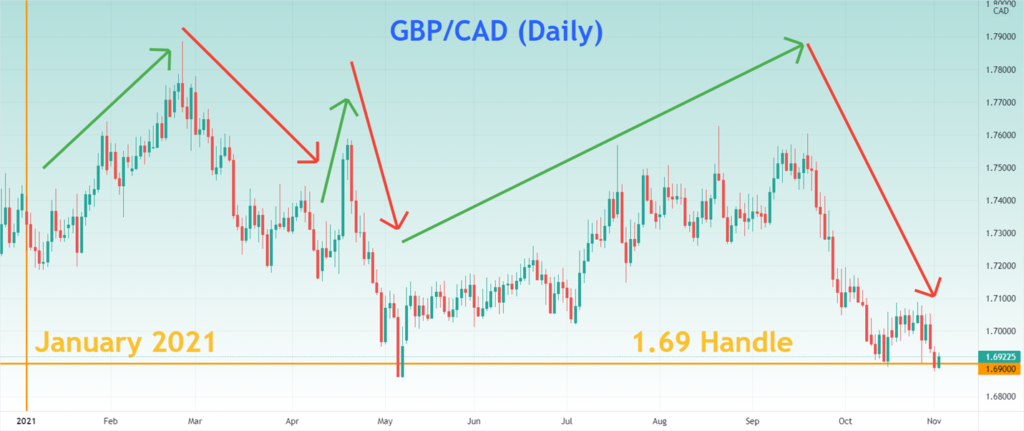
GBP/CAD’s third attempt to breach below the 1.69 handle
GBP/CAD has not been trading in a clear direction since the start of this year although every attempt to trend higher was met with a stronger reversal. Currently, GBP/CAD is trading around the 1.69 handle after the super hawkish tone coming in from the Bank of Canada. The 1.69 handle has proven to be a strong support level this year given the previous two failed attempts to break below.
Hence, if oil prices were to rise due to the OPEC+ keeping its production hike unchanged at 400,000 bpd and if the Bank of England were to send out any dovish tone, we may be seeing a breach below the 1.69 handle for the first time in this year with a strong downside.
คำชี้แจง (Disclaimer) : เนื้อหาข้างต้นเป็นเพียงมุมมองของผู้เขียนแต่เพียงผู้เดียว และไม่ได้แสดงหรือสะท้อนถึงจุดยืนอย่างเป็นทางการของ Followme แต่อย่างใด Followme ไม่รับผิดชอบต่อความถูกต้อง ความครบถ้วน หรือความน่าเชื่อถือของข้อมูลที่ปรากฏ และจะไม่รับผิดชอบต่อการดำเนินการใด ๆ ที่เกิดขึ้นจากเนื้อหานั้น เว้นแต่จะมีการระบุไว้เป็นลายลักษณ์อักษรอย่างชัดเจน

