
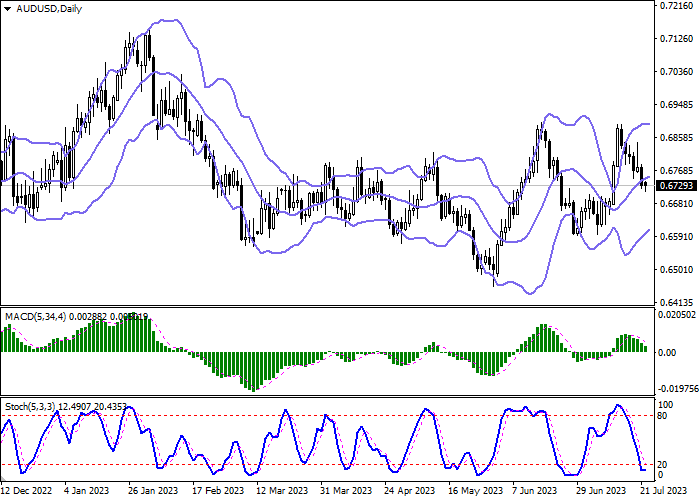
| Scenario | |
|---|---|
| Timeframe | Intraday |
| Recommendation | SELL STOP |
| Entry Point | 0.6700 |
| Take Profit | 0.6600 |
| Stop Loss | 0.6750 |
| Key Levels | 0.6594, 0.6622, 0.6661, 0.6700, 0.6750, 0.6800, 0.6850, 0.6900 |
| Alternative scenario | |
|---|---|
| Recommendation | BUY STOP |
| Entry Point | 0.6750 |
| Take Profit | 0.6850 |
| Stop Loss | 0.6700 |
| Key Levels | 0.6594, 0.6622, 0.6661, 0.6700, 0.6750, 0.6800, 0.6850, 0.6900 |
Current trend
The AUD/USD pair shows a moderate decline in the area of 0.6730, developing a fairly strong "bearish" momentum formed at the end of last week.
Pressure on the position of the instrument is exerted by expectations of further tightening of monetary conditions by the US Federal Reserve at a meeting on Wednesday. The regulator may raise the interest rate by 25 basis points to 5.50%, thus ending the current "hawkish" monetary policy cycle. On the same day, inflation statistics are expected to be published, which may have a significant impact on the position of the Reserve Bank of Australia (RBA). Forecasts suggest that the Consumer Price Index in the second quarter will slow down from 7.0% to 6.2% in annual terms and from 1.4% to 1.0% in quarterly terms. Today's data on business activity in Australia for July does not have a significant impact on the dynamics of the instrument. However, the Commonwealth Bank Services PMI fell from 50.3 points to 48.0 points, and the Manufacturing PMI rose from 48.2 points to 49.6 points, while the Composite PMI fell from 50.1 points to 48.3 points.
Economists are urging Australian Treasurer Jim Chalmers to give the RBA more voting rights on a new monetary policy board to be established by July next year, chaired by Michele Bullock, and composed of nine members: the governor and her deputy, the finance minister, and six external members. Thus, unlike the current structure, the central bank will no longer determine the outcome of each interest rate decision alone. However, analysts are confident that changes in the procedure will make it much more difficult for the RBA to pursue a "hawkish" course during periods of economic uncertainty, since with a majority of votes, external members of the new board will be no less important in choosing the vector of monetary policy than its head.
Support and resistance
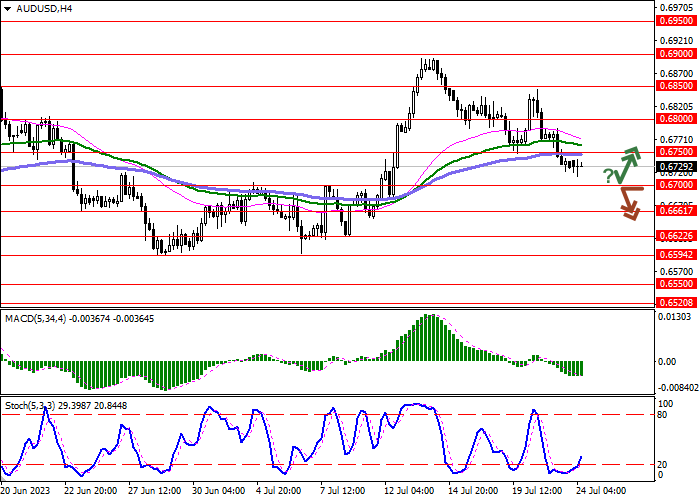
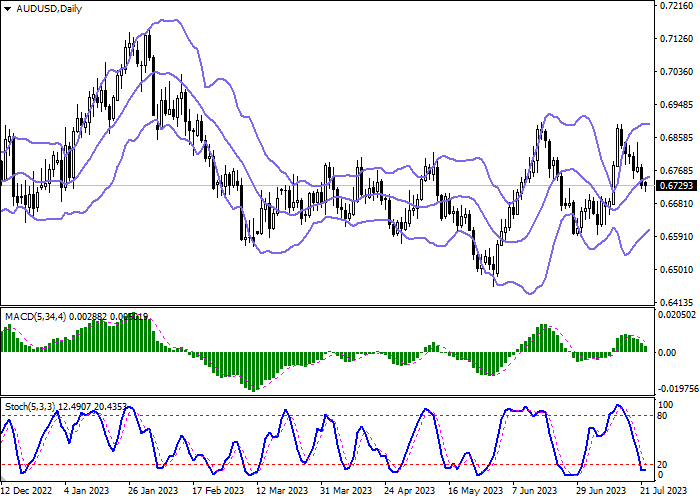
In the D1 chart, Bollinger Bands are reversing horizontally. The price range is narrowing, reflecting ambiguous dynamics of trading in the short term. MACD is falling, keeping a relatively strong sell signal (the histogram is below the signal line). Stochastic, having reached the zero level, reversed into the horizontal plane, indicating risks of the oversold Australian dollar in the ultra-short term.
Resistance levels: 0.6750, 0.6800, 0.6850, 0.6900.
Support levels: 0.6700, 0.6661, 0.6622, 0.6594.
Trading tips
Short positions may be opened after a breakdown of 0.6700 with the target at 0.6600. Stop-loss — 0.6750. Implementation time: 2-3 days.
A rebound from 0.6700 as from support followed by a breakout of 0.6750 may become a signal for opening new long positions with the target at 0.6850. Stop-loss — 0.6700.
คำชี้แจง (Disclaimer) : เนื้อหาข้างต้นเป็นเพียงมุมมองของผู้เขียนแต่เพียงผู้เดียว และไม่ได้แสดงหรือสะท้อนถึงจุดยืนอย่างเป็นทางการของ Followme แต่อย่างใด Followme ไม่รับผิดชอบต่อความถูกต้อง ความครบถ้วน หรือความน่าเชื่อถือของข้อมูลที่ปรากฏ และจะไม่รับผิดชอบต่อการดำเนินการใด ๆ ที่เกิดขึ้นจากเนื้อหานั้น เว้นแต่จะมีการระบุไว้เป็นลายลักษณ์อักษรอย่างชัดเจน