


Raw Trading Ltd
Under the impact of multiple negative impacts, the recent upward momentum of the US stock market has cracked.
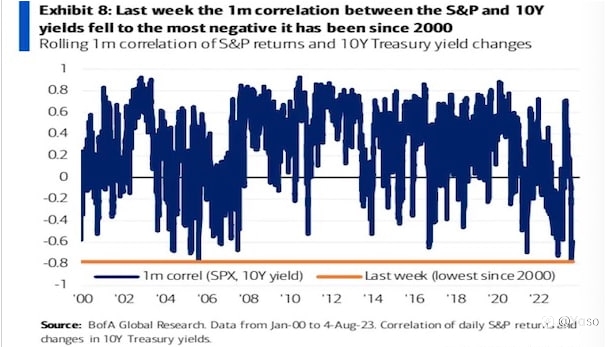
According to market analysts, Fitch’s downgrade of the U.S. sovereign credit rating and a series of government bond issuance plans have put new pressure on interest rates, thereby suppressing some optimism about the direction of the U.S. economy. As a result, the stock market has come under pressure, especially growth-oriented companies that are sensitive to interest rates. share.
In view of the large weight of high-cap technology stocks in the broader market index, many market participants are worried that if these stocks pull back further, it may turn into a wave of larger and wider sell-offs.
Last week, the tech-heavy Nasdaq 100 fell below its 50-day moving average for the first time since March, and its losses over the past two weeks were the biggest since December. The yield on the 10-year U.S. bond, seen as an "anchor" for global asset pricing, eased slightly but remained high at 4.168%, after hitting 4.206%, the highest level since November last week, the previous week.
"This (rise in U.S. Treasury yields) has spooked the stock market." Chris Harvey (Chris Harvey), head of equity strategy at Wells Fargo Bank, told China Business News that last week, the market's reaction to Microsoft, Netflix, Tesla, and Youtube. The negative reaction from companies such as Bubu and Advanced Micro Devices "suggests some cooling in optimism," and sentiment may remain subdued until the 10-year Treasury yield falls back below former resistance at 4.05%.
IC Markets
Tech stocks at risk of further pullback
According to FactSet data, on the 9th local time, Invesco QQQ Trust Series 1 (QQQ), an exchange-traded fund (ETF) tracking the Nasdaq 100 Index, closed below the 50-day moving average for the first time since March 10. As of the close on the 11th, the index had fallen by 4.8% in the past two weeks, according to Dow Jones Market Data (Dow Jones Market Data), which was the highest two-week decline record since December 23 last year, when it accumulated 10% in two weeks. fell 5%. Among the seven heavyweight technology stocks that contributed almost all the gains in the first half of the year, Apple, Nvidia, Microsoft and Tesla also closed below their 50-day moving averages last week.
Jonathan Krinsky, chief technical analyst at BTIG, said in a research report that QQQ and several other popular ETFs dominated by technology stocks are approaching the "volume pocket area" (volume pocket), facing an imminent collapse. Further callback risk.
According to Klinsky, the analysis of the volume and price data for the past three years shows that based on the historical volume and price situation, if QQQ continues to be lower than 368 US dollars, it will be vulnerable to a faster sell-off. Equity analysts use historical volume and price data to analyze possible support and resistance levels for a particular security.
Volume price indicators measure the volume of trades in a particular security over a range of prices over a certain period of time. In his analysis, Klinski looked back over the past three years.
He added that from the end of April to mid-June, QQQ has risen by about 16% in six weeks, which increases the possibility that the reversal will happen at the same speed, or even faster. QQQ was up about 38.5% this year as of last week's close, according to FactSet.
MT4, MT5, cTrader
คำชี้แจง (Disclaimer) : เนื้อหาข้างต้นเป็นเพียงมุมมองของผู้เขียนแต่เพียงผู้เดียว และไม่ได้แสดงหรือสะท้อนถึงจุดยืนอย่างเป็นทางการของ Followme แต่อย่างใด Followme ไม่รับผิดชอบต่อความถูกต้อง ความครบถ้วน หรือความน่าเชื่อถือของข้อมูลที่ปรากฏ และจะไม่รับผิดชอบต่อการดำเนินการใด ๆ ที่เกิดขึ้นจากเนื้อหานั้น เว้นแต่จะมีการระบุไว้เป็นลายลักษณ์อักษรอย่างชัดเจน

