


| Scenario | |
|---|---|
| Timeframe | Intraday |
| Recommendation | SELL STOP |
| Entry Point | 1.3695 |
| Take Profit | 1.3600 |
| Stop Loss | 1.3750 |
| Key Levels | 1.3550, 1.3600, 1.3650, 1.3700, 1.3750, 1.3800, 1.3853, 1.3900 |
| Alternative scenario | |
|---|---|
| Recommendation | BUY STOP |
| Entry Point | 1.3750 |
| Take Profit | 1.3853 |
| Stop Loss | 1.3700 |
| Key Levels | 1.3550, 1.3600, 1.3650, 1.3700, 1.3750, 1.3800, 1.3853, 1.3900 |
Current trend
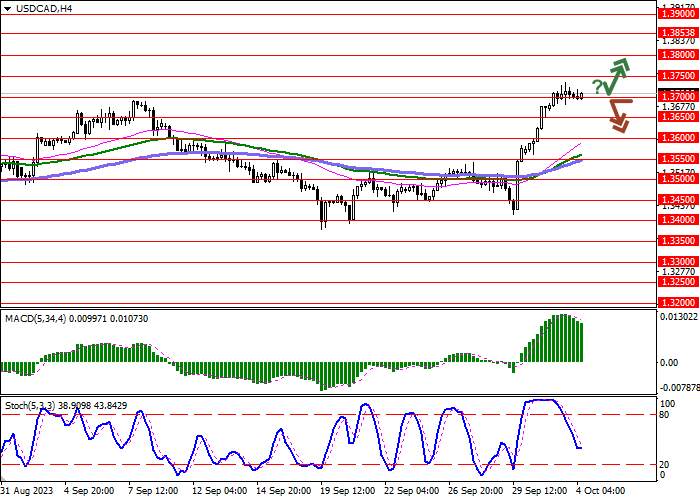
The USD/CAD pair is showing multidirectional dynamics, consolidating near 1.3700 and the record highs of the end of March.
Investors are closing part of their long positions in the US dollar in anticipation of the publication of macroeconomic statistics, which leads to a technical correction in the main currency pairs on the market. Today a report from Automatic Data Processing (ADP) will be presented on employment in the private sector: forecasts suggest a slowdown from 177.0 thousand to 153.0 thousand. Data from ADP will precede the Friday publication of the September labor market report: Nonfarm Payrolls are expected to increase by 170.0 thousand after 187.0 thousand in the previous month, and the Unemployment Rate may adjust from 3.8% to 3.7%. In addition, today investors will evaluate September data on business activity in the US services sector from the Institute for Supply Management (ISM): analysts predict that the index will drop from 54.5 points to 53.6 points.
A report on the Canadian labor market will also be published on Friday: analysts expect a decrease in the Net Change in Employment from 39.9 thousand to 20.0 thousand, while the Unemployment Rate may rise from 5.5% to 5.6%, and tomorrow investors will pay attention to the August statistics on Imports and Exports, as well as data on Ivey Purchasing Managers Index for September, where forecasts suggest a sharp reduction in the indicator from 53.5 points to 50.8 points.
Meanwhile, the external non-executive Deputy Governor of the Bank of Canada, Nicolas Vincent, speaking at the Montreal Chamber of Commerce, pointed out that the rise in savings during the coronavirus pandemic has caused excess demand. In addition, national companies are increasing the cost of their products and services much more often than before the pandemic, thereby contributing to even higher than expected inflation. This, in a sense, neutralizes the effect of the steps already taken by the regulator to tighten monetary policy to stabilize consumer prices around 2.0%.
Support and resistance
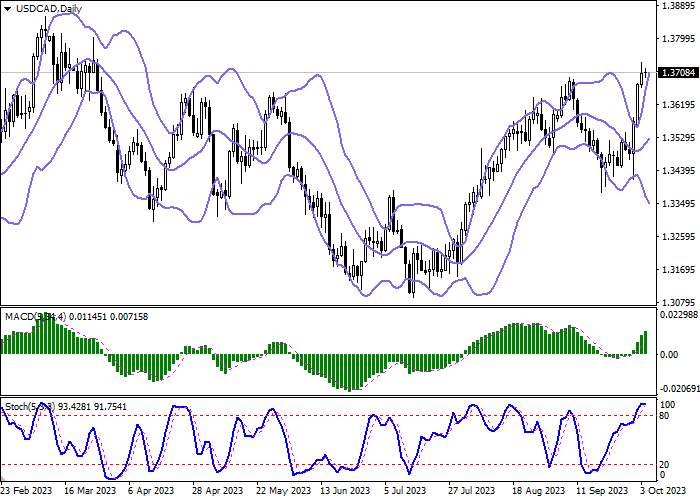
Bollinger Bands on the daily chart show a steady increase. The price range is expanding but it fails to conform to the surge of "bullish" activity at the moment. MACD grows, preserving a stable buy signal (located above the signal line). Stochastic, having approached its highs, reversed into a horizontal plane, indicating the risks of overbought US dollar in the ultra-short term.
Resistance levels: 1.3750, 1.3800, 1.3853, 1.3900.
Support levels: 1.3700, 1.3650, 1.3600, 1.3550.
Trading tips
Short positions may be opened after a breakdown of 1.3700 with the target at 1.3600. Stop-loss — 1.3750. Implementation time: 2-3 days.
A rebound from 1.3700 as from support followed by a breakout of 1.3750 may become a signal for opening new long positions with the target at 1.3853. Stop-loss — 1.3700.
คำชี้แจง (Disclaimer) : เนื้อหาข้างต้นเป็นเพียงมุมมองของผู้เขียนแต่เพียงผู้เดียว และไม่ได้แสดงหรือสะท้อนถึงจุดยืนอย่างเป็นทางการของ Followme แต่อย่างใด Followme ไม่รับผิดชอบต่อความถูกต้อง ความครบถ้วน หรือความน่าเชื่อถือของข้อมูลที่ปรากฏ และจะไม่รับผิดชอบต่อการดำเนินการใด ๆ ที่เกิดขึ้นจากเนื้อหานั้น เว้นแต่จะมีการระบุไว้เป็นลายลักษณ์อักษรอย่างชัดเจน

เขียนข้อความของคุณตอนนี้