



MACRO ECONOMIC CALENDAR
Weekly Economic Calendar: Week of 28 September – 2 October 2026
Followme News Desk | September 28, 2026 | All times GMT+8
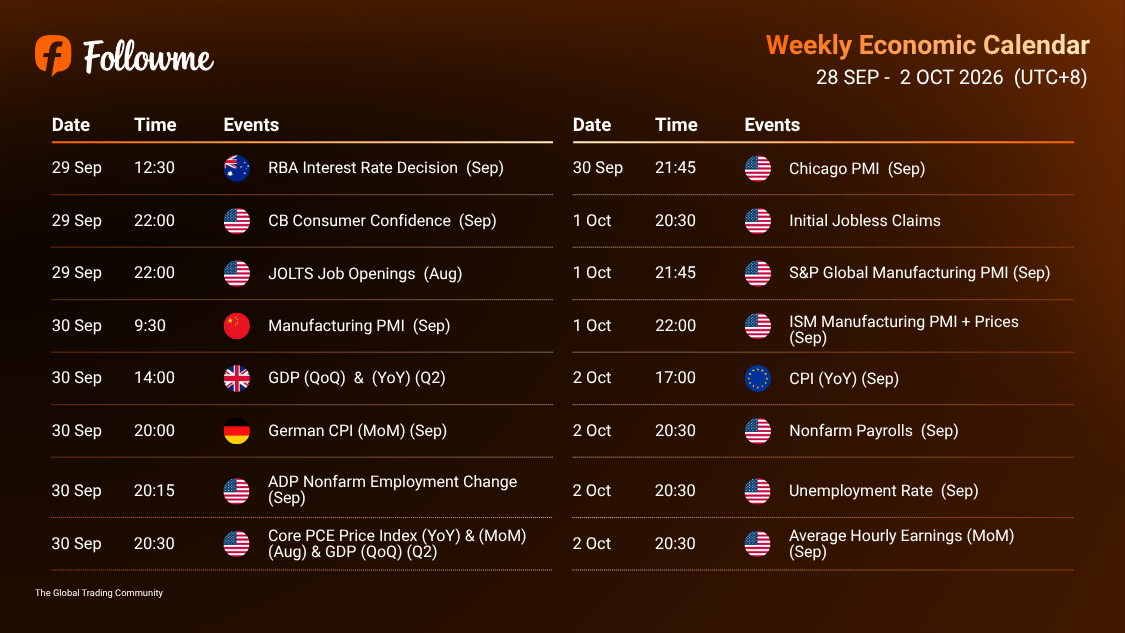
This week's economic calendar is heavily focused on the RBA Interest Rate Decision, U.S. CB Consumer Confidence, JOLTS Job Openings, China Manufacturing PMI, UK GDP (QoQ and YoY) Q2, German CPI (MoM), U.S. ADP Nonfarm Employment Change, Core PCE Price Index (YoY and MoM), U.S. GDP (QoQ) Q2, Chicago PMI, U.S. Initial Jobless Claims, S&P Global Manufacturing PMI, ISM Manufacturing PMI and Prices, EU CPI (YoY), U.S. Nonfarm Payrolls, Unemployment Rate and Average Hourly Earnings. Tuesday opens with the RBA, Consumer Confidence and JOLTS before Wednesday arrives as the most loaded session of the week, China PMI, UK GDP, German CPI, ADP, Core PCE, GDP and Chicago PMI all concentrating on the same day. Thursday follows with claims and manufacturing data, and Friday closes with EU CPI and the NFP.
Nonfarm Payrolls is the standout event. With the forecast at just 55K against a prior reading of 21K, the labour market picture is the most concerning it has been in some time, and everything earlier in the week will be read as a signal for what Friday delivers. ADP on Wednesday is the first direct read at 47K forecast. It's already pointing toward another historically weak payroll print, and a miss would start a USD selloff before the week's biggest event even arrives.
Key Events This Week
🕐 All times shown are GMT+8
| Date | Time | CCY | Event | Forecast | Previous |
|---|---|---|---|---|---|
| 29/9 | 12:30 | 🇦🇺 AUD | RBA Interest Rate Decision (Sep) | 4.35% | 4.35% |
| 22:00 | 🇺🇸 USD | CB Consumer Confidence (Sep) | 90.3 | 90.2 | |
| 22:00 | 🇺🇸 USD | JOLTS Job Openings (Aug) | 7.330M | 7.182M | |
| 30/9 | 9:30 | 🇨🇳 CNY | Manufacturing PMI (Sep) | 49.5 | 49.2 |
| 14:00 | 🇬🇧 GBP | GDP (QoQ) (Q2) | 0.40% | 0.60% | |
| 14:00 | 🇬🇧 GBP | GDP (YoY) (Q2) | 1.10% | 0.90% | |
| 20:00 | 🇩🇪 DEM | German CPI (MoM) (Sep) | 0.20% | 0.80% | |
| 20:15 | ⭐ 🇺🇸 USD | ADP Nonfarm Employment Change (Sep) | 47.00K | 46.00K | |
| 20:30 | 🇺🇸 USD | Core PCE Price Index (YoY) (Aug) | 3.30% | 3.30% | |
| 20:30 | 🇺🇸 USD | Core PCE Price Index (MoM) (Aug) | 0.20% | 0.10% | |
| 20:30 | 🇺🇸 USD | GDP (QoQ) (Q2) | 1.50% | 2.10% | |
| 21:45 | 🇺🇸 USD | Chicago PMI (Sep) | 57.8 | 57.6 | |
| 1/10 | 20:30 | 🇺🇸 USD | Initial Jobless Claims | 207.00K | 206.00K |
| 21:45 | 🇺🇸 USD | S&P Global Manufacturing PMI (Sep) | 53.6 | 53.9 | |
| 22:00 | 🇺🇸 USD | ISM Manufacturing PMI (Sep) | 55.2 | 55.6 | |
| 22:00 | 🇺🇸 USD | ISM Manufacturing Prices (Sep) | 70.5 | 71.1 | |
| 2/10 | 17:00 | 🇪🇺 EUR | CPI (YoY) (Sep) | 3.30% | 2.90% |
| 20:30 | ⭐ 🇺🇸 USD | Nonfarm Payrolls (Sep) | 55.00K | 21.00K | |
| 20:30 | 🇺🇸 USD | Unemployment Rate (Sep) | 4.10% | 4.10% | |
| 20:30 | 🇺🇸 USD | Average Hourly Earnings (MoM) (Sep) | 0.30% | 0.20% |
Macro Analysis
🇦🇺 RBA Interest Rate Decision and AUD Outlook
The RBA is expected to hold at 4.35%, unchanged from the prior meeting. A hold is the most likely outcome and broadly priced in. The real question is whether the accompanying statement gives any hint about what comes next. Australian inflation has been proving stickier than the RBA would like, and any language that signals the board remains comfortable at current levels would support AUD heading into a week that builds toward Friday's NFP. A more cautious tone suggesting the committee is watching the global slowdown more closely could weigh on AUD, particularly if China's PMI data the following morning also disappoints.
🇺🇸 U.S. CB Consumer Confidence
CB Consumer Confidence for September is forecast at 90.3, barely above 90.2 prior essentially flat. A reading this close to forecast won't move markets much on its own, but any deviation matters in the context of a week where the consumer picture is being built piece by piece ahead of Friday's payrolls. A meaningful drop below 90 would raise questions about whether sentiment is starting to soften faster than the data otherwise suggests. A beat above 91 would provide a quiet but useful signal that households are holding up despite recent labour market softness.
🇺🇸 U.S. JOLTS Job Openings
JOLTS Job Openings for August are forecast at 7.330M, up from 7.182M prior. A recovery in job openings after the recent weakness would be a constructive signal. It would suggest that hiring demand hasn't collapsed even as actual job creation has softened. That kind of divergence between openings and payrolls isn't unusual at turning points, and a strong JOLTS number could reduce some of the anxiety about Friday's NFP forecast. A reading that misses and falls below 7.182M, or worse, drops toward 7.000M, would immediately intensify concern about the labour market and start moving USD lower before the week's bigger events even arrive.
🇨🇳 China Manufacturing PMI
PMI for September is forecast at 49.5, down from 49.2 prior still below the expansion line, still contracting, just a little less so. The number is low enough that even a small beat above 49.5 wouldn't change the narrative much. What would matter is a meaningful surprise in either direction. A reading above 50 would be the kind of outcome that shifts risk appetite broadly commodity currencies would rally, risk pairs would move, and the global growth story would get a more optimistic read heading into the rest of Wednesday's heavy session. A further deterioration below 49.2 would add a risk-off tone to the start of the day that carries into the U.S. trading.
🇬🇧 UK GDP (QoQ and YoY) Q2
UK GDP for Q2 lands with a quarterly reading forecast at 0.40%, a pullback from 0.60% prior, and an annual reading of 1.10%, up from 0.90%. The quarterly deceleration is the more notable of the two coming after last week's mixed UK data, a drop from 0.60% to 0.40% suggests the UK economy's pace of expansion is moderating even if the direction is still positive. GBP's reaction will depend heavily on whether the miss on the quarterly figure is large or small. A reading that holds closer to 0.60% would support Sterling, while anything below 0.40% would weigh on the pound heading into a session already packed with German CPI, ADP and U.S. PCE data.
🇩🇪 German CPI (MoM)
CPI for September is forecast at 0.20%, easing from 0.80% prior. After last month's sharp rebound, a pullback to 0.20% would suggest the inflation surge wasn't sustained which gives the ECB more flexibility to continue easing if growth data keeps softening. A reading in line with forecast would be broadly EUR-neutral in a session already dominated by U.S. events. A surprise to the upside, back toward 0.80% or above, would complicate the ECB easing case and give EUR a lift that could amplify whatever EUR/USD moves are generated by the U.S. data later the same day.
🇺🇸 U.S. ADP Nonfarm Employment Change and NFP Preview
ADP for September is forecast at 47K, barely above the 46K prior and both numbers are historically very soft. As the most direct preview of Friday's NFP, a print this close to forecast would already validate significant labour market slowing. A beat materially above 60K would be enough to shift positioning and reduce the downside risk around Friday's payroll number. A miss below 46K, or worse, a negative print, would be the most alarming outcome of the week and would likely start a broad USD selloff that accelerates into Friday. This is one of those weeks where ADP matters almost as much as NFP itself.
🇺🇸 Core PCE Price Index
Core PCE (YoY) for August is forecast at 3.30%, unchanged from prior, while Core PCE (MoM) is forecast at 0.20%, up from 0.10%. The fact that the annual rate isn't decelerating further would normally be a mildly USD-positive signal, but landing in the same session as ADP, GDP and the Chicago PMI makes the read more complicated. If PCE holds at 3.30% alongside a soft ADP and a downward GDP revision, the market has to decide whether inflation staying firm outweighs the growth deterioration. A monthly core reading above 0.20% would be the cleaner USD-positive signal, giving the Fed less urgency to cut even as payrolls slow.
🇺🇸 U.S. GDP (QoQ) Q2
GDP is forecast at 1.50%, a downward revision from the prior reading of 2.10%. That's a significant step down if confirmed, it would be the clearest sign yet that U.S. growth through the second quarter was weaker than the initial estimate suggested. In a week where the labour market picture is already softening, a GDP revision of this magnitude landing alongside ADP and PCE in the same session would make Wednesday genuinely difficult for USD. A reading that holds closer to 2.10% or surprises to the upside would be the more USD-supportive outcome and would give the Fed more breathing room before the NFP data arrives on Friday.
🇺🇸 U.S. Chicago PMI
PMI for September is forecast at 57.8, holding near 57.6 prior essentially unchanged and firmly in expansion. In a session already carrying ADP, PCE and GDP, the Chicago PMI will be the last data point of the day and may not generate much standalone reaction unless it's a clear outlier. A reading at or above 57.8 would keep the manufacturing picture constructive heading into Thursday's ISM data. A sharp miss below 55 would add concern about industrial momentum in a session where growth signals are already mixed.
🇺🇸 U.S. Initial Jobless Claims
Claims are forecast at 207K, ticking up from 206K prior no meaningful change. In a week where NFP is the Friday standout, claims on Thursday serve as the final labour market cross-check before the payroll data lands. A reading at or below 207K would provide some reassurance that layoffs haven't jumped ahead of Friday. A clear move above 212K or higher, coming after a potentially soft ADP on Wednesday, would compound the bearish USD positioning heading into the payroll release and make it very difficult for the Dollar to find buyers before the weekend.
🇺🇸 U.S. S&P Global and ISM Manufacturing PMI and Prices
S&P Global Manufacturing PMI for September is forecast at 53.6, barely below 53.9 prior effectively flat. ISM Manufacturing PMI is forecast at 55.2, easing from 55.6, while ISM Manufacturing Prices are forecast at 70.5, down from 71.1. The slight easing across all three is consistent with the broader softening picture but doesn't change the expansion narrative. A set of readings that comes in broadly at forecast would be a neutral-to-mildly-positive USD outcome in a session that follows Wednesday's more consequential data. A sharper-than-expected drop in either ISM PMI or prices would add another bearish layer heading into Friday.
🇪🇺 EU CPI (YoY) and EUR Inflation Dynamics
Eurozone CPI for September is forecast at 3.30%, jumping from 2.90% prior. That's a meaningful acceleration if confirmed, it would give the ECB real pause about cutting rates further and would support EUR heading into the weekend. Landing on the same day as U.S. NFP makes Friday's session particularly complex. If EU CPI beats while U.S. payrolls disappoint, EUR/USD could push sharply higher in a move that's driven by both a hawkish ECB read and a dovish Fed read simultaneously. A mistake that keeps Eurozone inflation closer to 2.90% would reduce ECB hawkishness and allow USD to find more support even if NFP also disappoints.
🇺🇸 U.S. Nonfarm Payrolls, Unemployment Rate and Average Hourly Earnings
This is the week's standout release. Nonfarm Payrolls for September are forecast at 55K, barely above last month's 21K both historically weak numbers that imply the labour market is deteriorating more rapidly than the broader economy suggests. The Unemployment Rate is forecast to hold at 4.10%, while Average Hourly Earnings (MoM) are forecast at 0.30%, up from 0.20%. A payroll print near 55K would almost certainly accelerate rate cut expectations and deliver a meaningful USD selloff. A surprise beat above 100K would flip the week's narrative entirely. The wages number matters too, a 0.30% print alongside sub-60K payrolls would create a confusing signal, and the reaction could be volatile as markets try to decide which number to follow.
Speculative Outlook for USD Traders
This week is genuinely one of the most data-dense of the year. Tuesday sets the early tone RBA, Consumer Confidence and JOLTS. Wednesday is the most important session of the week before Friday, with ADP, PCE, GDP and Chicago PMI all concentrated in the same afternoon. Thursday follows with claims and manufacturing data. Friday delivers the NFP alongside EU CPI.
The ADP print on Wednesday is critical. With NFP forecast at just 55K, anything ADP shows will be read as a direct preview. A weak ADP near 47K validates the bearish payroll forecast and starts a USD selloff that carries into the weekend. A strong ADP above 70K would flip sentiment and make the 55K NFP forecast look overly pessimistic. Wednesday's GDP revision is the other number to see if the economy grew less than 2.10% in Q2, and ADP confirms labour market softening, and PCE stays stuck at 3.30%, the Fed is caught between slowing growth and sticky inflation, which tends to produce sharp and unpredictable USD moves. Friday's session will close the week, and with EU CPI also landing at the same time as NFP, the cross-market dynamics could produce some of the largest moves in EUR/USD the market has seen in months.
🟢 Bullish USD Scenario — Stronger Dollar Case
- ADP Beats Meaningfully Above 60K on Wednesday — A private-sector jobs number well above the 47K forecast would immediately reduce the credibility of the 55K NFP estimate and support USD into Thursday.
- NFP Beats 55K on Friday — A payroll number materially above forecast would be the single biggest USD catalyst of the week, reversing whatever bearish positioning built up through Wednesday's data.
- GDP Holds Near 2.10% — If the Q2 revision doesn't fall as sharply as feared, the growth picture stays more intact and USD has less to fight against heading into NFP.
- Core PCE MoM Beats 0.20% — A monthly PCE read above forecast on the same day as the GDP revision would signal that inflation is staying stickier than expected and reduce the urgency for the Fed to cut.
- JOLTS Holds Above 7.330M — Job openings recovering would suggest hiring demand hasn't collapsed and reduce some of the anxiety around Friday's payroll number.
- EU CPI Disappoints Below 3.30% on Friday — A softer Eurozone inflation print while U.S. Payrolls surprise to the upside would hit EUR/USD from both sides and deliver a sharp Dollar rally into the weekend.
🟡 Wild Cards — High Whipsaw Risk
- GDP Down, PCE Up, ADP Soft All Wednesday — If three of Wednesday's four major releases all point in different directions, the market may struggle to form a clean view and USD could whipsaw aggressively as competing signals fight for dominance.
- ADP Beats Then NFP Misses — A strong Wednesday ADP triggers USD buying, then a soft NFP on Friday reverses it all. Anyone who is positioned aggressively mid-week gets caught twice in the same week.
- EU CPI Beats While NFP Disappoints — Eurozone inflation accelerating to 3.30% or above on the same day as a weak U.S. Payroll print would produce one of the more powerful EUR/USD bullish setups of the year.
- China PMI Breaks Above 50 — An unexpected return to expansion in Chinese manufacturing on Wednesday morning would shift global risk sentiment quickly and could create commodity and risk-correlated currency moves that complicate how USD pairs trade through the rest of the day.
- Wages Beat While Payrolls Miss — Average Hourly Earnings at 0.30% or above alongside a sub-50K payroll print would give markets a genuinely confusing signal and could produce violent intraday swings as traders debate whether to price inflation or growth risk.
- UK GDP Miss and German CPI Beat Together — If the UK economy slows more than expected, while German inflation rebounds, EUR/GBP could move sharply and create cross-currency flows that amplify EUR/USD moves from the U.S. session later on the same Wednesday.
🔴 Bearish USD Scenario — Weaker Dollar Case
- NFP Disappoints at or Below 55K — A payroll print this week would trigger immediate and broad USD selling as rate cut expectations lock in heading into the weekend.
- Unemployment Rate Ticks to 4.20% or Above — A rise in the jobless rate alongside weak payrolls would deepen the bearish USD reaction and validate the labour market deterioration narrative that's been building for weeks.
- ADP Misses Below 46K on Wednesday — A worse-than-expected private-sector print would start the USD selloff before NFP even arrives and build bearish momentum that Friday's data only confirms.
- GDP Revised Down Below 1.50% — A sharper-than-expected downward revision to Q2 growth alongside soft ADP and sticky PCE would create a stagflationary read that is one of the most difficult environments for USD bulls.
- EU CPI Beats 3.30% While NFP Disappoints — The combination of a hawkish Eurozone inflation surprise and a weak U.S. Payroll print would be among the most powerful EUR/USD bullish catalysts the market could deliver on a single Friday.
- JOLTS Falls Below 7.182M — A deterioration in job openings below last month's prior would raise the stakes around Friday's NFP and start moving USD lower before any of the major Wednesday data, even prints.
Check out the full calendar here: Followme Economic Calendar Tool
Follow Followme for the newest market updates




คำชี้แจง (Disclaimer) : เนื้อหาข้างต้นเป็นเพียงมุมมองของผู้เขียนแต่เพียงผู้เดียว และไม่ได้แสดงหรือสะท้อนถึงจุดยืนอย่างเป็นทางการของ Followme แต่อย่างใด Followme ไม่รับผิดชอบต่อความถูกต้อง ความครบถ้วน หรือความน่าเชื่อถือของข้อมูลที่ปรากฏ และจะไม่รับผิดชอบต่อการดำเนินการใด ๆ ที่เกิดขึ้นจากเนื้อหานั้น เว้นแต่จะมีการระบุไว้เป็นลายลักษณ์อักษรอย่างชัดเจน

