

MARKET REVIEW FOREX RBA
RBA Signals More Hikes, but Strong Dollar Caps Aussie Gains
Unanimous RBA hike minutes leave the door open to further tightening, but oil-driven US dollar strength and Wednesday’s US CPI are setting the direction for AUD/USD.
Followme News Desk | October 13, 2026
Executive Summary
The Reserve Bank of Australia has made clear that September’s rate hike may not be its last. Minutes released Tuesday show all nine board members backed the 25bp move to 4.60%. The board argued that waiting for more evidence on inflation could prove costly. The Australian dollar barely reacted. AUD/USD slipped toward 0.6950 after stalling just under 0.7000, because the US dollar is the biggest force in FX right now.
The Dollar Index is holding near an 18-month high around 102.50. It is being supported by three things: Houthi strikes on Saudi energy assets, attacks on shipping around the Strait of Hormuz, and WTI crude trading above $92.
The focus now moves to Wednesday’s US CPI, one of the last major releases before the Fed’s late-October meeting. Markets price roughly an 81% chance the Fed holds this month, so the real question is whether a hot print pulls a December hike firmly onto the table. Fed Chair Kevin Warsh speaks at the IMF on Friday.
For traders, takeaway is straightforward. A hawkish RBA is not enough to lift the Aussie while oil and Fed hike risk keep the dollar bid.
Market Review
Australia’s central bank has now explained in detail why it raised rates last month, and the message is that it may not be finished. Minutes from the RBA’s September 28–29 meeting show the board voted unanimously to lift the cash rate by 25 basis points to 4.60%. The board’s case was that moving promptly was the best way to keep inflation expectations anchored.
Several of the upside risks the board flagged in August have already played out. The Middle East conflict has widened, and oil prices are well above the RBA’s earlier assumptions. July inflation also came hotter than staff expected. Notably, staff attributed that surprise mainly to domestic capacity pressure rather than imported energy costs.
The board also kept further tightening on the table. Members said the forecast for inflation to return to the middle of the 2–3% target band by late 2027 relied on a series of favourable developments that now look unlikely. Before the meeting, markets were pricing roughly another 15bp of tightening by year-end and about 30bp more in the first half of 2027.
The passage that matters most for FX traders concerns the currency itself. The board noted that global neutral rates may have risen. If other central banks keep tightening and Australia stands still, the Australian dollar could weaken and effectively loosen domestic financial conditions. In other words, the RBA is watching the rate differential closely. That sits uneasily with Governor Michele Bullock’s recent, more neutral suggestion that three hikes might prove sufficient.
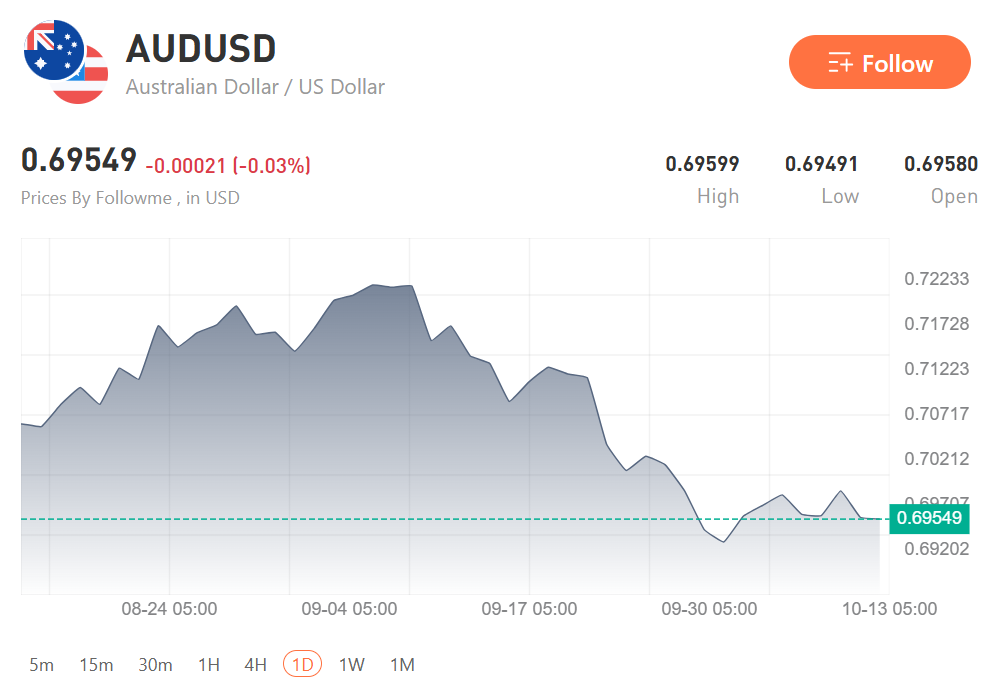
The Aussie’s reaction was muted and slightly negative. AUD/USD fell close to 0.4% on Monday after failing just below 0.7000, and it held near 0.6950 after the minutes were released. The pressure came from the dollar side of the pair.
The US Dollar Index rose to around 102.56, near its highest level since April 2025. Investors moved into safe havens after Houthi strikes on Saudi Arabia, weekend attacks on two tankers, and Iranian strikes on vessels in the Strait of Hormuz. WTI climbed above $93, and Brent traded above $103 earlier in the Asian session.
Oil got partial relief from another direction. President Trump announced an energy-infrastructure truce between Russia and Ukraine, along with a deal allowing more than 2.25 million barrels of Russian diesel onto US and global markets. Russia struck a power plant soon afterwards, however, and the market is not treating the truce as durable supply relief.
On the Fed, Cleveland Fed President Beth Hammack repeated that further hikes are needed, though she favours a gradual pace. The Fed raised rates in September for the first time since 2023.
CME FedWatch now shows about an 81% probability of a hold at the late-October meeting, up from 51% a month ago. That shifts attention to whether Wednesday’s CPI revives December hike bets. Pepperstone’s Chris Weston noted that a hot print could push the market toward back-to-back hikes in December and January, instead of the current expectation of a pause until March.
AUD/USD price as of 13 October 2026 - View Live Chart →
The Facts
- RBA decision: Unanimous 25bp hike to 4.60% at the September 28–29 meeting. The board said it will raise rates further if required.
- Inflation outlook: A return to the 2–3% target midpoint by late 2027 no longer looks likely. Petrol and diesel prices are 13% above the RBA’s August forecast.
- Australian economy: June-quarter GDP beat expectations as business investment rose more than 10% year on year. Household consumption slowed below trend, and unemployment rose to 4.6% in August.
- Currency risk flagged: The RBA warned that tighter policy abroad could weaken the AUD if domestic rates stay flat. It also noted the trade-weighted AUD is still about 5% higher this year.
- AUD/USD: Trading near 0.6950 after a rejection just below 0.7000, down roughly 0.13% after the minutes.
- US Dollar Index: Around 102.50, near an 18-month high on safe-haven demand.
- Oil: WTI is above $92–93 and Brent above $103, driven by Houthi attacks on Saudi Arabia and Hormuz shipping disruption.
- Fed pricing: About an 81% chance of an October hold per CME FedWatch. December hike bets remain live.
- US yields and gold: The US 10-year Treasury yield is near 5.24%. Gold has slipped below $4,200 as the dollar and yields firm.
What It Means
The RBA minutes are hawkish on paper, but they have not changed the AUD/USD story. The RBA is tightening into an environment where the Fed is also tightening, oil is above $90, and global bond yields are at multi-decade highs. In that setting, rate differentials are not moving in Australia’s favour quickly enough to offset safe-haven demand for the dollar.
The RBA’s comment on the exchange rate is worth noting. By saying that a weaker AUD could undo some of its tightening, the board has effectively signalled it would be uncomfortable with a sharp Aussie sell-off. That gives AUD a degree of policy support on deeper dips, even if it does not provide upside momentum on its own.
The biggest driver this week is the US CPI. A hot reading would reinforce December hike pricing and likely push the dollar toward fresh highs, putting the lower 0.69 area in AUD/USD back in play. A softer reading would give the Aussie room to retest 0.7000, especially if the RBA’s hawkish bias starts to show up more clearly in rate pricing.
Oil links all of this together. Energy prices are feeding inflation fears in both the US and Australia, and they are also driving the safe-haven bid for the dollar. As long as the Houthi attacks and the Hormuz disruption continue, the dollar has a geopolitical floor under it.
What Traders Should Watch
AUD/USD at 0.7000: The pair has failed there twice in recent sessions. FXStreet’s technical outlook places resistance at the moving-average cluster near 0.7088 and support at the rising trend lines from 0.6897 and 0.6865. A daily close below 0.6865 would extend the bearish phase.
US CPI (Wednesday): This is the key event of the week. Watch whether Fed funds futures move toward a December hike after the release, because that will matter more than the headline number itself.
Fed Chair Warsh (Friday, IMF): He is the last major Fed voice before the blackout period. Any comment on the pace of tightening could reset dollar pricing.
WTI near $90: Holding above that level keeps inflation fears and safe-haven flows alive. A slide back toward the mid-$80s would ease pressure on risk currencies such as AUD.
Middle East headlines: Further Houthi strikes on Saudi energy assets or new incidents in the Strait of Hormuz remain the fastest route to another leg higher in the dollar.
Australian data and RBA pricing: Watch for any rise in pricing of a November or December RBA hike after the minutes. That would be the first sign the market is taking the board’s hawkish bias seriously.
The Bottom Line The RBA has shown it is willing to keep tightening, but in FX the currency side with the stronger momentum usually sets the direction. For now, that is the dollar, supported by oil above $90 and a Fed that has not ruled out moving again. Until Wednesday’s CPI says otherwise, 0.7000 is the ceiling for AUD/USD, and every Middle East headline still matters more than central bank minutes.
Follow us for daily market insights, analysis, and the tools you need to trade with confidence.
Want to stay ahead of major macro developments that move the market? 👉 Follow Followme and check out the Weekly Economic Calendar
October 13, 2026 | This report is for informational purposes only and does not constitute financial advice. © 2026 Followme News
Download Followme Application


Follow us on:


คำชี้แจง (Disclaimer) : เนื้อหาข้างต้นเป็นเพียงมุมมองของผู้เขียนแต่เพียงผู้เดียว และไม่ได้แสดงหรือสะท้อนถึงจุดยืนอย่างเป็นทางการของ Followme แต่อย่างใด Followme ไม่รับผิดชอบต่อความถูกต้อง ความครบถ้วน หรือความน่าเชื่อถือของข้อมูลที่ปรากฏ และจะไม่รับผิดชอบต่อการดำเนินการใด ๆ ที่เกิดขึ้นจากเนื้อหานั้น เว้นแต่จะมีการระบุไว้เป็นลายลักษณ์อักษรอย่างชัดเจน